

It’s a common worry, especially for expectant or hopeful mothers: can X-rays affect fertility or harm a pregnancy? There’s a lot of alarming information circulating about X-rays causing birth defects or miscarriage. Here’s what the actual science says, so you can make informed decisions rather than avoiding necessary medical care out of fear.
How X-rays Work
X-rays are one of the most common diagnostic imaging tools in medicine. The equipment emits a brief burst of radiation that passes through the body; tissues absorb it differently depending on density, which is what creates the image.

Doctors use the resulting images to diagnose a wide range of conditions. Radiation dose depends on the type of X-ray, the equipment, and the size of the patient, and is measured in units like millisieverts (mSv) or rads — not a unit of mass like milligrams, despite that being a common mix-up.
X-rays are widely used to evaluate bones, joints, teeth, the lungs, and the cardiovascular system, and to monitor recovery after surgery or injury. During the scan, technologists position the patient carefully to get the clearest image with the lowest necessary dose. On the resulting black-and-white image, areas that X-rays pass through easily (like air-filled lungs) appear dark, while denser tissue that blocks more radiation (like bone) appears light.
Do X-rays Actually Affect Fertility or Pregnancy?
X-rays do involve ionizing radiation, and at high enough doses, radiation can damage cells and genetic material. The key question is dose — and standard diagnostic X-rays use doses far lower than what’s associated with these effects.

According to the American College of Obstetricians and Gynecologists (ACOG), a single diagnostic X-ray does not deliver a radiation dose high enough to threaten fetal wellbeing or fertility. To put this in perspective:
- A chest X-ray exposes the fetus to a tiny fraction of a rad — far below the level of concern.
- Even X-rays of the abdomen or lower spine typically deliver well under 1 rad.
- Research indicates that a cumulative fetal radiation dose below 5 rad (50 mGy) has not been shown to meaningfully increase the risk of miscarriage or birth defects.
- Reaching 5 rad from diagnostic imaging alone would generally require multiple, repeated X-rays or CT scans focused directly on the abdomen or pelvis — not a single routine X-ray.
That said, extremely high radiation doses — well beyond diagnostic imaging, such as radiation therapy or major accidental exposure — can affect bone marrow function, immune function, and fertility, and are linked to increased cancer risk. This is a completely different scale of exposure than a diagnostic X-ray, which is why context and dose matter more than the word “radiation” itself.

Because the developing fetus is most sensitive to radiation during the first trimester, and because reproductive organs are somewhat radiosensitive in general, doctors take reasonable precautions — like shielding and choosing the lowest effective dose — for anyone who is, or might be, pregnant. But this doesn’t mean necessary X-rays should be avoided altogether. ACOG and the American College of Radiology are clear that a medically necessary X-ray, CT scan, or other imaging study should not be withheld from a pregnant patient, since delaying diagnosis of a real medical problem (like a fracture, appendicitis, or pneumonia) usually carries more risk than the radiation exposure itself. When ultrasound or MRI can answer the same clinical question, doctors often use those instead simply because they don’t involve ionizing radiation — not necessarily because an X-ray would be unsafe.
If you are, or think you might be, pregnant or breastfeeding, it’s still important to tell your doctor or the imaging technologist before any X-ray. This allows them to weigh the necessity of the test, use shielding where appropriate, and choose the lowest effective radiation dose — not necessarily to cancel the test.
What to Do If You Had an X-ray Before Knowing You Were Pregnant
This is a common situation, and it’s rarely a cause for serious concern. Since most standard diagnostic X-rays (chest, dental, limbs) expose the fetus to far less radiation than the 5-rad threshold associated with increased risk, the chance of harm from a single routine X-ray taken before you knew you were pregnant is very low.
If this happens to you, mention it to your OB-GYN at your next visit. They can review exactly which type of X-ray was performed and, if needed, estimate the fetal dose to reassure you — but in the vast majority of cases, no special action is needed beyond routine prenatal care.
How to Minimize Risk When X-rays Are Necessary
If you need an X-ray while pregnant, trying to conceive, or breastfeeding, a few standard precautions help minimize any risk:
- Tell your provider about your pregnancy status: Always mention if you’re pregnant, might be pregnant, or are breastfeeding before any imaging test. This helps your care team choose the safest, most appropriate approach.
- Follow contrast instructions carefully: If a contrast agent is needed (for certain scans), follow your provider’s instructions on timing and preparation, including any required fasting or bowel prep for digestive tract imaging.
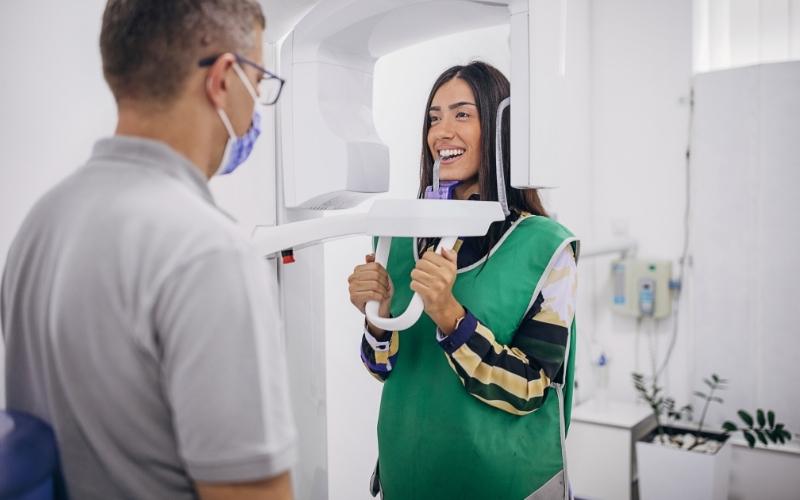
- Use shielding when appropriate: A lead apron or shield over the abdomen and pelvis is standard practice for X-rays of other body areas, for anyone — pregnant or not — to protect reproductive organs from unnecessary radiation exposure.
- Remove metal objects: Jewelry, watches, belts, and hairpins can interfere with image quality and should be removed before the scan.
- Choose a licensed, accredited facility: Reputable imaging centers use well-maintained, regularly calibrated equipment and follow radiation safety protocols set by regulatory bodies like the FDA, which helps ensure both accurate results and minimal necessary exposure.

In the U.S., diagnostic imaging equipment and facilities are regulated by agencies like the FDA, and radiologic technologists undergo specific training and certification in radiation safety. Medical staff who are regularly exposed to radiation as part of their job also undergo routine monitoring to track their own cumulative exposure over time — a level of oversight that doesn’t apply to an occasional patient getting a diagnostic X-ray.
So, do X-rays affect fertility? At the doses used in routine diagnostic imaging, the evidence doesn’t support meaningful harm to fertility or a developing pregnancy. The benefits of an accurate, timely diagnosis generally far outweigh the very small risk from a properly performed, appropriately shielded diagnostic X-ray. If you have specific concerns — especially if you’re pregnant, trying to conceive, or have had repeated imaging — talk with your doctor, who can give you guidance specific to your situation. (If you’re currently trying to conceive, our guide on early signs of pregnancy can help you know what to watch for.) This article is intended for general education and isn’t a substitute for personalized medical advice.
Frequently Asked Questions
Can a single X-ray cause infertility?
No. At the radiation doses used in routine diagnostic X-rays, there's no evidence of a meaningful effect on fertility. Concerns about radiation and fertility apply to much higher doses, like those used in radiation therapy, not standard diagnostic imaging.
Is it safe to have an X-ray if I don’t know I’m pregnant yet?
In most cases, yes. Standard diagnostic X-rays like chest, dental, or limb X-rays deliver far less radiation than the threshold associated with increased pregnancy risk. If this happens to you, mention it to your doctor at your next visit for reassurance, but it's rarely a cause for concern.
Should pregnant women avoid X-rays completely?
No. Medically necessary X-rays should not be withheld during pregnancy, since untreated medical problems often carry more risk than the radiation exposure itself. Doctors take precautions like shielding and choosing the lowest effective dose, and may use ultrasound or MRI when they can answer the same question without radiation.
How much radiation does a typical X-ray deliver to a fetus?
It varies by the type of X-ray, but most routine diagnostic X-rays deliver only a small fraction of the 5-rad (50 mGy) threshold that research has associated with increased risk. A single chest X-ray, for example, delivers a tiny amount of radiation to the fetus.
Why do technicians use a lead apron during X-rays?
A lead apron shields the abdomen and pelvis from unnecessary radiation exposure during X-rays of other body parts. This is standard practice for all patients, not just those who are pregnant, since reproductive organs are more sensitive to radiation than many other tissues.
References
- American College of Obstetricians and Gynecologists (ACOG) — guidelines for diagnostic imaging during pregnancy (acog.org).
- American College of Radiology / RadiologyInfo.org — radiation dose in X-ray and CT exams, and safety in pregnancy (radiologyinfo.org).
- U.S. Food and Drug Administration — radiation-emitting products and medical imaging safety (fda.gov).
- Centers for Disease Control and Prevention — radiation and pregnancy information for clinicians (cdc.gov).