

Basketball is beloved worldwide, but many fans don’t realize that official court dimensions actually vary depending on the governing body. Here’s an accurate breakdown of basketball court sizes and regulations, based on official FIBA and NBA specifications.
Standard Basketball Court Size
Like other sports with regulated playing areas, basketball courts follow official size standards — though the exact numbers differ slightly between organizations. Internationally, courts follow specifications set by FIBA (the International Basketball Federation); in the U.S. professional league, the NBA uses its own slightly larger standard.
FIBA Standard
- Length: 28m (approximately 91.9 ft), marked by the baselines at each end.
- Width: 15m (approximately 49.2 ft), marked by the sidelines.
- Minimum ceiling height: 7m (approximately 23 ft).
FIBA also requires a minimum clearance of 2m (about 6.5 ft) beyond the sidelines and baselines, free of obstacles — meaning team benches and other equipment must stay at least that far from the court itself.
NBA Standard
The NBA (and NCAA college basketball) uses a slightly larger court:
- Length: 94 ft (28.65m)
- Width: 50 ft (15.24m)
Smaller and Amateur Courts
For smaller venues, local clubs, or lower-level competitions, FIBA permits reduced court sizes, with a minimum of about 26m (85 ft) in length and 14m (46 ft) in width. High school courts in the U.S. are sometimes smaller still, commonly 84 ft long. Regardless of overall size, court lines are required to be 2 inches (5cm) wide and painted in a color that contrasts clearly with the playing surface — typically white or a bold accent color.
Key Zones on the Basketball Court
Beyond overall dimensions, understanding the court’s functional zones helps make sense of the game:
- Center Circle: Located at midcourt, this is where the opening jump ball takes place at the start of the game.
- Free-Throw Lane (“The Paint” or “The Key”): The lane extending from the baseline to the free-throw line. A player with the ball in the low post generally has 3 seconds to shoot, pass, or move out before a violation is called.
- Restricted Area: A small semicircle directly under the basket where a defender generally can’t draw an offensive charging foul.
- Three-Point Area: Shots made from beyond this line are worth three points instead of two.
- Free-Throw Line: Where players stand to shoot free throws after a shooting foul.

Boundary Lines and Markings (FIBA Standard)
- Center Circle: 3.6m (11.8 ft) in diameter, centered at midcourt.
- Free-Throw Line: Positioned 4.6m (about 15 ft) from the backboard, with each line measuring 3.6m (11.8 ft) across, centered between the sidelines.
- Free-Throw Lane: A rectangular area formed by the baseline, the free-throw line, and two parallel lines connecting them — approximately 5.8m (19 ft) long and 4.9m (16 ft) wide under FIBA rules (the NBA lane is narrower at the baseline but similar in overall shape).
- Restricted Area: A semicircle under the basket with a 1.25m (about 4.1 ft) radius, centered beneath the rim.
- Three-Point Line: Made up of two lines running parallel to the sidelines, connected by an arc. Under FIBA rules, the arc has a radius of 6.75m (about 22.15 ft) from the point beneath the basket, with the straight side portions set roughly 0.9m from the sideline. (For comparison, the NBA’s arc extends to 23 ft 9 in at the top, narrowing to 22 ft in the corners.)
Basketball Hoop and Backboard Specifications
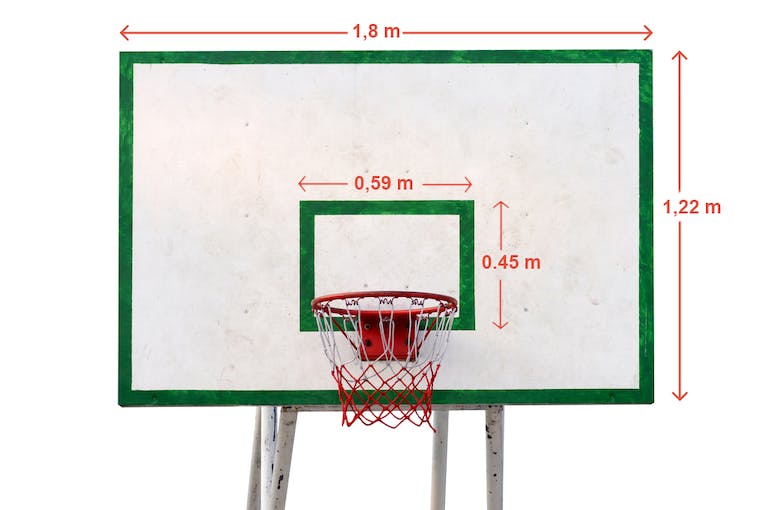
The basket is centered on each baseline. Standard backboard dimensions are 1.8m wide by 1.07m tall (about 6 ft by 3.5 ft), typically made of tempered glass or another rigid, regulation material. The backboard’s face is set back about 1.2m (4 ft) from the baseline. A smaller rectangle — 61cm by 46cm (24 in by 18 in) — is marked on the backboard directly behind the rim to help guide bank shots.
The rim sits 3.05m (10 ft) above the court surface, with an inner diameter of 45.72cm (18 in). A net, at least 40cm (about 16 in) long, hangs from the rim to help confirm a successful basket.
While basketball court dimensions vary somewhat by league and level of play, the core elements — rim height, general court layout, and key zones — stay broadly consistent across FIBA, NBA, and other organizations. Knowing the official measurements helps you understand the game better, whether you’re building a court, coaching, or just want to know why an NBA game feels a bit more spacious than an Olympic one. (For more sports court specifications, see our guides on badminton court dimensions and volleyball court sizing.)
Frequently Asked Questions
What is the official size of a basketball court?
Under FIBA rules, a standard court is 28m x 15m (about 91.9 ft x 49.2 ft). The NBA uses a slightly larger court at 94 ft x 50 ft (28.65m x 15.24m).
Why are NBA and FIBA basketball courts different sizes?
The NBA and FIBA developed their standards independently, resulting in the NBA court being slightly longer and wider. The difference affects spacing, pace of play, and shooting distances, including the three-point line.
How high is a basketball hoop?
The rim is set at 3.05m (10 ft) above the court surface at every level of play, from youth leagues through the NBA.
How far is the three-point line from the basket?
Under FIBA rules, the arc is set at a radius of 6.75m (about 22.15 ft). In the NBA, the arc extends to 23 ft 9 in at the top of the key, narrowing to 22 ft in the corners.
What size is a basketball backboard?
A standard backboard measures about 1.8m wide by 1.07m tall (roughly 6 ft by 3.5 ft), with a smaller 61cm by 46cm (24 in by 18 in) rectangle marked behind the rim.
References
- FIBA — Official Basketball Rules, Article 1: The Court (fiba.basketball).
- National Basketball Association (NBA) — official rulebook, court and equipment specifications (nba.com).
- NCAA — men’s and women’s basketball rulebook, court dimensions (ncaa.org).