

Working out at home is one of the easiest ways to stay active. You don’t need a gym membership, special equipment, or much space, just a mat and a little time.
Reducing belly fat matters for more than appearance. Excess fat around the waist, especially the deeper visceral fat that surrounds your organs, is linked to a higher risk of type 2 diabetes, heart disease, and high blood pressure. The good news is that regular exercise, combined with healthy eating, can make a real difference.
Below, you’ll find eight beginner-friendly core exercises you can do at home, with clear form tips, plus an honest look at what actually reduces belly fat.
First, the Truth About Ab Exercises and Belly Fat
Ab exercises strengthen your core muscles, but they don’t burn fat specifically from your stomach. This idea, called “spot reduction,” has been tested and doesn’t hold up. In one well-known study, adults who did seven ab exercises five days a week for six weeks built stronger, more enduring core muscles but saw no meaningful change in belly fat, waist circumference, or body fat percentage.
Your body draws on fat stores from all over when you burn energy. To lose belly fat, you need to reduce overall body fat through a combination of:
- Aerobic exercise such as brisk walking, cycling, swimming, or jogging. This is especially effective at reducing visceral fat.
- Strength training for all major muscle groups, which helps preserve muscle while you lose fat.
- A balanced diet that creates a modest calorie deficit.
- Good sleep and stress management, both of which affect appetite and fat storage.
So why do ab exercises at all? A strong core supports good posture, protects your lower back, improves balance, and makes everyday movements easier. And as you lose fat overall, stronger abdominal muscles help your midsection look firmer.
Before You Start
- Warm up for 5 minutes with marching in place, arm circles, or light walking.
- Use a yoga mat or carpeted floor to protect your back.
- Move slowly and with control. Quality matters more than the number of reps.
- Breathe throughout each exercise. As a rule of thumb, exhale as you lift or contract and inhale as you lower.
- Stop if you feel sharp pain, especially in your neck or lower back.
1. Basic Crunch
The crunch is the classic starting point for core training. It mainly works the rectus abdominis, the long muscle that runs down the front of your stomach.
- Lie on your back on a mat with your knees bent and feet flat on the floor, hip-width apart.
- Place your fingertips lightly behind your head, with your elbows pointing out to the sides.
- Inhale. As you exhale, tighten your abs and curl your head and shoulders a few inches off the floor.
- Pause briefly at the top, then inhale as you slowly lower back down.
Beginners: 2 to 3 sets of 10 reps.
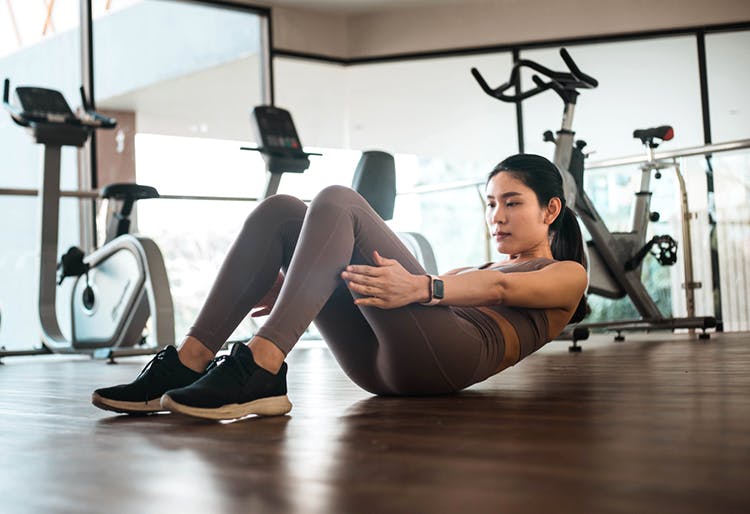
Form tip: Your lower back should stay on the floor. Use your abs, not your hands, to lift. Pulling on your head strains your neck. Keep a fist-sized space between your chin and chest.
2. Twisting Crunch
Once basic crunches feel comfortable, usually after a few weeks, the twisting crunch adds a rotation that brings in your obliques, the muscles along the sides of your waist.
- Start in the basic crunch position: on your back, knees bent, feet flat, fingertips behind your head.
- As you exhale, curl up and rotate your torso so your right shoulder moves toward your left knee.
- Inhale and lower back down with control.
- Repeat on the other side, bringing your left shoulder toward your right knee. That’s one rep.
Beginners: 2 to 3 sets of 10 reps.

Form tip: Twist from your ribs, not just your elbow. Keep breathing steadily rather than holding your breath.
3. Side Crunch (Oblique Crunch)
The side crunch focuses on the obliques. It won’t burn fat from your sides specifically, but stronger obliques help support your spine and improve rotation.

- Lie on your back with your knees bent, then let both knees drop together to your left side so they rest on the floor.
- Keep your shoulders as square to the ceiling as you can, with your fingertips behind your head.
- As you exhale, curl your shoulders straight up off the floor. You’ll feel the work along your right side.
- Inhale and lower slowly. Finish your reps, then switch your knees to the right side.
Beginners: 2 to 3 sets of 10 reps on each side.
4. Reverse Crunch
Instead of lifting your shoulders, the reverse crunch curls your hips toward your chest. Many people find it a good way to feel the lower part of the abs working, and it’s often easier on the neck than regular crunches.
- Lie on your back with your arms by your sides, palms down.
- Lift your legs so your knees are bent at 90 degrees and your shins are parallel to the floor.
- As you exhale, tighten your abs and curl your hips a few inches off the floor, bringing your knees toward your chest.
- Inhale and slowly lower your hips back down, keeping your knees bent.
Beginners: 2 to 3 sets of 10 reps.

Form tip: Use your abs, not momentum. Avoid swinging your legs or rocking. Your shoulders and head stay relaxed on the floor.
5. Vertical Leg Crunch
This variation raises your legs straight up, which makes the crunch a bit more challenging and also stretches your hamstrings.
- Lie on your back and extend your legs straight up toward the ceiling, with your feet together and a slight bend in your knees.
- Place your fingertips behind your head, elbows out to the sides.
- As you exhale, curl your head and shoulders off the floor, reaching your chest toward your feet.
- Inhale and lower slowly. Keep the movement controlled.
Beginners: 2 to 3 sets of 10 to 12 reps.

Form tip: Keep your legs steady and your knees soft. You only need to lift high enough to feel your abs working. If your hamstrings are tight, bend your knees more.
6. Bicycle Crunch
The bicycle crunch combines a crunch with a twisting leg motion. It works both the front abs and the obliques, and research measuring muscle activity has found it to be one of the most effective ab exercises.
- Lie on your back with your fingertips behind your head and lift your shoulders slightly off the floor.
- Lift your legs so your knees are bent at 90 degrees, shins parallel to the floor.
- Bring your right knee toward your chest while straightening your left leg, and rotate so your left elbow moves toward your right knee.
- Switch sides in a slow pedaling motion, bringing your right elbow toward your left knee. Each side counts as one rep.
Beginners: 2 to 3 sets of 10 to 12 reps on each side.

Form tip: Keep your lower back pressed into the floor, and don’t yank on your neck. Slower is better. Rushing through the pedaling motion lets momentum do the work.
7. Lunge With a Twist
This standing exercise strengthens your legs and glutes while your core works to rotate and stabilize your torso. It also makes a good warm-up because it gets your heart rate up a little.
- Stand with your feet hip-width apart and your arms extended in front of you at chest height. You can hold a water bottle or light ball for extra challenge.
- Step your left foot forward and lower into a lunge until both knees are bent at about 90 degrees.
- At the bottom of the lunge, rotate your torso and arms toward the left.
- Rotate back to center, push through your front heel to stand, and repeat on the right side.
Beginners: 2 to 3 sets of 10 reps (5 on each side).

Form tip: Keep your chest lifted and your back straight. Your front knee should stay over your ankle, not drift past your toes or cave inward. Rotate from your upper body while your hips stay facing forward.
8. Stomach Vacuum
The stomach vacuum trains the transverse abdominis, the deepest abdominal muscle, which wraps around your midsection like a corset. It won’t burn fat, but it can improve core control and posture.
- Stand tall with your hands on your hips.
- Exhale slowly and completely, pushing out as much air as you can.
- With your lungs empty, draw your belly button in toward your spine as far as you comfortably can.
- Hold for 10 to 15 seconds, then release and breathe normally. Work up to 20 seconds over time.
- Repeat 5 to 10 times.

Form tip: Do this on an empty stomach for comfort. Stop if you feel dizzy or lightheaded. Skip this exercise if you’re pregnant, have high blood pressure, or have a heart or lung condition, unless your doctor says it’s OK.
Safety Tips
- Pregnancy: After the first trimester, avoid exercises that have you lying flat on your back for long periods. Talk with your doctor about pregnancy-safe core work.
- After giving birth: If you notice a ridge or gap down the middle of your belly when you crunch, you may have diastasis recti (separation of the abdominal muscles). Check with your doctor or a pelvic floor physical therapist before doing crunches.
- Back or neck pain: If crunches bother you, try reverse crunches or planks instead, and check with a health care provider about persistent pain.
- Health conditions: If you have heart disease, diabetes, or another chronic condition, or you’ve been inactive for a long time, talk with your doctor before starting a new exercise program.
A Simple Weekly Plan
Ab exercises work best as one part of a complete routine. For general health, the U.S. Physical Activity Guidelines recommend that adults get:
- At least 150 to 300 minutes of moderate aerobic activity per week, such as brisk walking, or 75 to 150 minutes of vigorous activity, such as running.
- Muscle-strengthening activities for all major muscle groups on 2 or more days a week.
A realistic plan for beginners could look like this:
- 5 days a week: 30 minutes of brisk walking or another aerobic activity you enjoy.
- 2 to 3 days a week: A core circuit using 4 to 5 of the exercises above, along with full-body moves like squats and push-ups.
- Every day: Balanced meals built around vegetables, fruits, whole grains, lean protein, and healthy fats, with fewer sugary drinks, refined carbs, and ultra-processed foods.
Want to mix up your cardio? Try these treadmill exercises you probably didn’t know.
Frequently Asked Questions
What exercises are best for losing belly fat?
Aerobic exercise such as brisk walking, jogging, cycling, and swimming is the most effective type of exercise for reducing belly fat, especially the visceral fat around your organs. Combining aerobic activity with strength training gives the best overall results. Ab exercises strengthen your core but don’t burn belly fat on their own.
Can you lose belly fat with exercise alone?
It’s possible, but it’s much harder without changes to your diet. Most people get the best results by pairing regular exercise with a balanced diet that limits added sugars, refined carbohydrates, and ultra-processed foods. Healthy fats from foods like nuts, olive oil, and fish are part of a healthy diet and don’t need to be avoided.
Do crunches burn belly fat?
No. Crunches strengthen your abdominal muscles, but they don’t burn fat from your stomach specifically. Studies show that ab exercises alone don’t reduce belly fat or waist size. You need to lower your overall body fat through aerobic exercise, strength training, and diet.
Is swimming good for losing belly fat?
Yes. Swimming is a full-body aerobic exercise that burns calories and is easy on the joints, making it a good choice for reducing overall body fat, including belly fat. Adding core and strength exercises builds muscle, but it won’t make fat come off your belly faster.
How long does it take to lose belly fat?
It varies from person to person. With consistent exercise and healthy eating, many people notice changes in their waist measurement within a few weeks to a few months. A safe, sustainable rate of weight loss is about 1 to 2 pounds per week.
The Bottom Line
The eight exercises in this guide are an easy, equipment-free way to build a stronger core at home. Just keep realistic expectations: ab exercises strengthen the muscles but don’t melt fat from your belly. To actually shrink your waistline, combine core work with regular aerobic exercise, full-body strength training, a balanced diet, and good sleep. Stay consistent, focus on good form, and the results will follow.
References
- Vispute SS, Smith JD, LeCheminant JD, Hurley KS. The Effect of Abdominal Exercise on Abdominal Fat. Journal of Strength and Conditioning Research, 2011;25(9):2559–2564.
- U.S. Department of Health and Human Services. Physical Activity Guidelines for Americans, 2nd Edition. 2018.
- Harvard Health Publishing. To Lose Weight, Especially Harmful Belly Fat, Combine Diet and Exercise.
- American College of Obstetricians and Gynecologists. Exercise During Pregnancy.
- Centers for Disease Control and Prevention. Steps for Losing Weight.