

Women are showing up at the gym more than ever, and strength training has become a popular way to build strength, improve body composition, and feel more confident. Getting the most out of it means following a well-structured routine. Below are three beginner-friendly exercise series that target different muscle groups, along with the safety basics worth knowing before you start.
Before You Start: A Few Safety Basics
A few habits will help you get more out of these exercises while reducing injury risk:
- Warm up first: Spend 5–10 minutes on light cardio and dynamic movements (like leg swings or arm circles) before lifting. This increases blood flow and prepares your joints and muscles for the work ahead.
- Prioritize form over weight: Especially as a beginner, use a lighter weight you can control with good form rather than a heavier one that causes you to compensate with poor technique. If you’re new to a movement, consider having a trainer check your form.
- Rest between sessions: Give muscle groups roughly 48 hours to recover before training them again, and build in at least one full rest day per week.
- Listen to your body: Muscle fatigue is normal; sharp or joint pain is not. Stop if something feels wrong, and check with a doctor before starting a new exercise program if you have any underlying health conditions.
Series 1: Legs and Core
This series targets the legs, glutes, and core. It includes the goblet squat, lunge, and skater jump — together, they build lower-body strength and support core stability, which contributes to better overall muscle tone in this area over time (though spot-reducing fat from a specific area with targeted exercise alone isn’t something exercise science supports — overall body composition change comes from a combination of strength training, cardiovascular activity, and nutrition).
Exercise 1: Goblet Squat
A great squat variation for beginners, using a dumbbell or kettlebell.
Stand with feet hip-width apart, holding a dumbbell or kettlebell close to your chest with both hands. Bend your knees and push your hips back until your thighs are roughly parallel to the ground, keeping your chest up and back straight. Push through your heels to stand back up. Do 3 sets of 15 reps.
Exercise 2: Lunge
Stand with feet shoulder-width apart, back straight. Step forward with one foot and bend both knees until your front thigh and shin form roughly a 90-degree angle. Push through your front heel to return to standing. Do 3 sets of 10 reps per leg.

Exercise 3: Skater Jump
A more dynamic, higher-intensity move than the first two. Start standing upright, then jump laterally to one side, landing on that leg while sweeping the opposite leg behind you for balance. Pause briefly, then jump to the other side and repeat. Do 3 sets of 10 reps per side. If balance is a challenge at first, practice the lateral step without the jump until you feel steady.
Series 2: Back, Shoulders, and Core
This series combines pulling movements and isolation exercises to target your back, shoulders, and the oblique muscles that support your core.
Exercise 1: Lat Pull-Down
Using a lat pull-down machine, sit down, select an appropriate weight, and grip the bar with both hands, wider than shoulder-width. Pull the bar down to chest level, squeezing your shoulder blades together, then slowly return to the starting position. Do 3 sets of 15 reps.
Exercise 2: One-Arm Dumbbell Row
Place your left knee and left hand on a flat bench, keeping your back flat and roughly parallel to the ground. Hold a dumbbell in your right hand, arm hanging straight down. Pull the dumbbell up toward your ribcage, leading with your elbow and squeezing your back muscle, then lower with control. Do 3 sets of 10 reps, then switch sides.
Exercise 3: TRX Row
Using a TRX suspension trainer, hold the handles and lean back with your arms extended and body in a straight line, feet planted. Pull your chest up toward the handles, keeping your elbows close to your body, then lower back down with control. Do 3 sets of 15 reps.
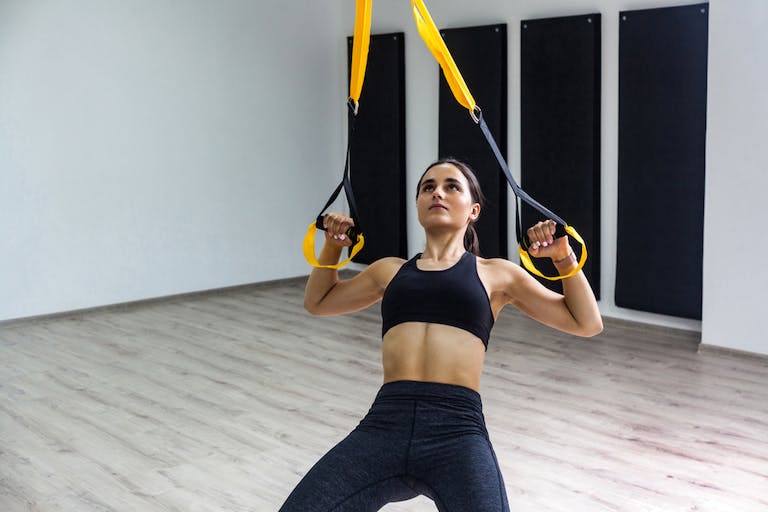
A quick clarification on TRX row difficulty: standing more upright (a smaller lean-back angle) makes the row easier, since your body weight contributes less resistance; leaning back further (more horizontal) makes it harder, since more of your body weight is working against you. Start more upright and gradually lean back further as you build strength.
Exercise 4: Reverse Flye
Hold a dumbbell in each hand and hinge forward at the hips until your back is roughly parallel to the ground, arms hanging with a slight bend in the elbows. Raise both arms out to the sides until they reach about shoulder height, squeezing your shoulder blades together at the top. Lower with control. Do 3 sets of 15 reps.
Exercise 5: Lateral Raise
Stand tall holding a dumbbell in each hand at your sides. With a slight bend in your elbows, raise both arms out to the sides until they reach shoulder height, then lower with control. Do 3 sets of 15 reps.
Series 3: Chest and Arms
This series combines bodyweight and dumbbell exercises to target the chest, biceps, and triceps — a solid, beginner-friendly upper-body routine.
Exercise 1: Push-Ups
Start in a plank position, hands and feet shoulder-width apart, arms straight. Bend your elbows to lower your chest toward the floor, then push back up to the starting position. If a full push-up is too challenging at first, try it from your knees to build strength. Do 3 sets of 15 reps (or as many as you can manage with good form).
Exercise 2: Biceps Curl
Stand with feet shoulder-width apart, holding a dumbbell in each hand at your sides, palms facing forward. Bend your elbows to curl the weights up toward your shoulders, keeping your upper arms still, then lower with control. Do 3 sets of 15 reps.

Exercise 3: Triceps Press-Down
Using a cable machine with the handle set at head height, stand facing the machine and grip the handle with both hands. Keeping your elbows tucked close to your body, push the handle down until your arms are fully extended, then let it rise back with control. Do 3 sets of 15 reps.
These three beginner-friendly series work the legs, glutes, back, shoulders, chest, arms, and core, giving you a well-rounded introduction to strength training. Start with lighter weights, focus on form, and build up gradually as your strength improves — consistency matters far more than intensity when you’re just getting started. This article is intended for general education; a certified personal trainer can provide hands-on form guidance, which is especially valuable when learning new movements. (For more, check out our guides on how to warm up before the gym and getting started with kettlebells.)
Frequently Asked Questions
How many times a week should beginners do these exercise series?
2 to 3 times a week, with at least a day of rest between sessions targeting the same muscle groups, is a reasonable starting frequency for beginners.
Do I need to warm up before starting these exercises?
Yes. A 5–10 minute warm-up with light cardio and dynamic stretching helps prepare your muscles and joints and reduces injury risk before any strength training session.
Will these exercises give me a flat stomach?
Not directly — you can't "spot reduce" fat from one area through targeted exercise. These moves build core and lower-body strength and tone, but visible changes in any specific area depend on overall body composition, which is influenced by a combination of strength training, cardio, and nutrition.
What weight should beginners start with?
Start with a weight light enough that you can complete all reps with good form, even on the last set. It's better to master form with a lighter weight and gradually increase than to start too heavy and risk injury.
Is it normal to feel sore after these workouts?
Mild muscle soreness in the day or two after a new workout is normal, especially when starting out. Sharp pain, joint pain, or discomfort that doesn't improve is not normal and is worth checking with a doctor or trainer.
References
- American Council on Exercise (ACE) — strength training fundamentals for beginners (acefitness.org).
- American College of Sports Medicine (ACSM) — exercise guidelines and warm-up recommendations (acsm.org).
- Mayo Clinic — strength training: get stronger, leaner, healthier (mayoclinic.org).